
Editor’s Note: this interview is based on a recorded Zoom call with Dr. Michelle Voss, Health, Brain & Cognition Lab director, and Emery Styron, community liaison, interviewing Matt Schaefer, a personal trainer on staff at the Campus Wellness and Recreation Center. This article is a part of our series of blog posts focusing on fitness options for older adults.
By Emery Styron
“Sometimes it’s a dime and sometimes it’s a dollar,” says Matt Schaefer, a personal trainer who works mainly with middle-aged to older adults at the University of Iowa Campus Recreation and Wellness Center (CRWC). “If you’re here, you’re crushing it. Any time you’re at the gym, you’re making an investment in yourself. You’re putting money in the bank.”

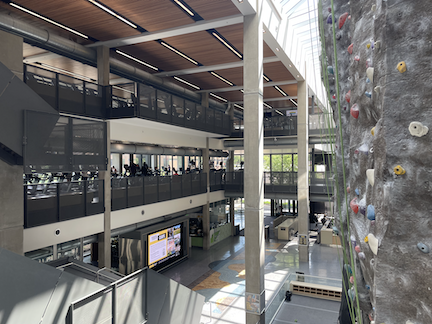
Some 25 personal trainers work out of the multi-level, glass-walled CRWC at the southwest corner of Burlington and South Madison streets in downtown Iowa City, but only three specialize in mature clients. “Polly Price, Martha Gordon and I hold up the older side of the age spectrum,” says Matt. “Older clients find us a little more relatable.”
“When my client says ‘My shoulders today, I just can't, we will work around that. I say, ‘You let me know when your shoulders are able to handle the stuff, and if never, we can certainly build a regimen that challenges you and keeps you coming back for more without ever putting your shoulder in a compromised position.’”
Matt comes to his profession by way of a lifetime as a “gym rat” steeped in “bro science” and a 20-year career as a historian and archivist at the Herbert Hoover Presidential Library in West Branch.
Challenged by a friend to make good on a longstanding ambition, Matt committed himself to earning certification as a personal trainer after retiring from his federal career. He passed his American Council on Exercise (ACE) certification exam on his first attempt in 2023 and has been working with older clients since.
He and his colleagues coordinate their efforts to give older clients the kind of fitness training they are seeking. Matt specializes in strength training, progressive resistance and adaptation. Martha’s practice is more yoga-centric, and Polly offers a “broader array of tools,” including strength/resistance training, functional training, senior mobility/balance training and boot camp-style programming.
“If I had a client come to me and say, ‘I really want to work on flexibility and I really want to be able to do the tree pose,’ I would say ‘I’m not your guy. You should talk to Martha or Polly because they are much better at the flexibility training than I am.’”
VIDEO: Matt on Working with Older Clients
Asked by HBC Lab Director Michelle Voss “where does the kind of science where physical activity affects the brain come into how you think about programming?” Matt has plenty to say.
“I’m a huge fan of evidence-based science. It comes into play for me all the time. I bring it up with my clients without hitting them over the head with it. Aerobic activity demonstrably improves brain function, it doesn't matter once you get to a certain threshold it doesn't matter if you're white, black, Asian, male, female. Fill in the blank, it's going to benefit you. The science of weight training is beginning to get a wider base of evidence as well. I’m always excited to share with my clients, ‘Hey, leg press improves your brain. Grip strength has correlations with activities of daily living, independent living.’ You know, all of this stuff that we want to be able to do in our older age — and old age is a very elastic term — to be able to function in the world.”
“Working with older clients requires a careful approach, he says. “When I meet with a new client, I spend the first 20 to 30 minutes doing a rough and ready medical and exercise history. I push my clients to tell me if there is anything I need to be aware of building a program? Do you have cardiac issues? Do you have joint issues? If the answer is yes, we will plan accordingly.
“For young trainers it's about maximum recoverable volume. They’re working with athletes. We’re going to push the envelope. We’re going to work you as long as we can, as hard as we can, then recover and do it again. As an older adult, recovery is slower. You get to a certain age; you’re not going to bounce back from a hard workout. It’s going to take you a couple of days, so program accordingly.
“I always work with minimum effective volume, and I emphasize to my clients I want you to come out of this workout feeling like ‘That was challenging, but I could do it again in two days without much fuss. I might be a little sore tomorrow but the day after tomorrow I'll be fine. We do recover.’ The body, despite what some fitness influencers would have you believe, hasn’t changed much in the last 600 or 6,000 years.”
One aspect of the HBC Lab’s research is working to better understand barriers to adherence that arise when people begin exercise programs, typically negative “affect” or feelings connected to physical activity.
VIDEO: Matt on Adherence to a Fitness Program
For Matt’s clients, “the biggest barrier to me that I see is cost,” he says. “To sign up for a set of sessions at the U of I Rec Center is not cheap … between $40 and $45 per session. I understand the value of money. I'll work with you as long as you wish, but my goal here is to get you confident enough in your own body and in the gym to fly solo. I have several clients, they took four sessions and they have what they need.”
Others continue to invest time and money in personal training. “I have five clients that I’m not teaching them anything much new. I’m more like an accountability person for them, a program for them so they don’t have to think about it.”
The fun factor is another key to adherence, says Matt. “Fun means different things to different people. I try to make it challenging, try to keep it fresh.”
Keeping it fresh for older clients also means allowing time to recover “If you have weight training or resistance training twice a week and anything in between, whether it’s aerobic or just sitting in the sauna or stretching, you build enough buffer in so that you only have two heavy days a week.,” says Matt.
For workouts on the non-heavy days, he advises no more than “25 or 30 minutes, or you begin to lose your zest, your focus. You start doing sloppy reps, junk volume. You want to be sure you’re intentional and connected to the work you're doing.”
VIDEO: Matt on Maintenance and Recovery
Goal setting can be important to motivation and adherence, he says, adding that goals will change over time. He tells of a client who successfully trained for a Grand Canyon hike, down and back. "Now he keeps re-signing up because he says, ‘I want to take my son, I want to do this with my grandkids.’ That for him has been a recurring goal.”
“There's a lot of ‘personal’ in personal training,” Matt notes. He shared with one client the fitness challenge he created for himself when he turned 60 — 60 reps of bench press at 80% of his body weight. The client said, “I’m turning 60 this year. Can you design one of those programs for me?”
“I get as excited when my clients hit a challenge like that as for anything I do for myself. It’s like you didn't know, but you could, and you did. I think that's why they keep signing up with me.”
Another benefit of personal fitness is the opportunity to feel in control. “In the world today, so much is outside us, you don't have agency. You can't push a button or pull a lever and make something happen. In the gym, you can and you can say ‘All right, I can't do it today, but I can work up to it. And when I do that, I'm going to feel on top of the world that I set a challenge for myself. I met a challenge. Bring it on. What’s next?'”